#32 All By Myself

Over the years, I have compiled a list of music called “music that makes me cry”. On the top of the list is Glenn Gould’s arrangement of the Prelude to Act 1 of Meistersinger by Wagner.

Toward the end of the piece, Gould overdubbed a second piano part to the prelude. In a Rolling Stone interview, he explained:

“The Meistersinger is not a problem because it’s so contrapuntal that it plays itself, although I must say it’s the only place where I’m going to have to cheat, because I’m going to have to put earphones on for the last three minutes, for the place where he brings back all the themes, and you have to play it four hands. It’s a piece that I’ve played just as a party piece all my life, and you can get through the first seven minutes fine, and then you say, “OK, which themes are we leaving out tonight?” — there’s just no way. So I will do it as an overdub.”

It was certainly possible to feature a guest artist to play that second part. But Gould did it himself anyways. In a way, it makes sense – why involve another pianist for just 3 minutes of music? What if Gould wanted to play this live? Would the other pianist just sit there and wait? And maybe this was not meant to be performed live? And sure, it’s fun to play with others, but you know yourself best (or, do we really know ourselves?) and it was a good chance to carry our an entire concept all on your own.

It’s quite easy to “make music with yourself” today, with a loop pedal or an app. But back then, why would artists go to studio and record a full album all by themselves? For maximum control? Because it was a novel idea and not many have done that? It’s a challenge to play with oneself? An opportunity to reflect different sides of the artist?

I don’t have an answer (what do I have answers for?). And different people do the same thing for different reasons. I do hope to make an album all by myself in the future. I will let you know how it feels when the album is finished. But until then, I would like to share a few older recordings I know of that are studio productions, with artists performing with themselves.
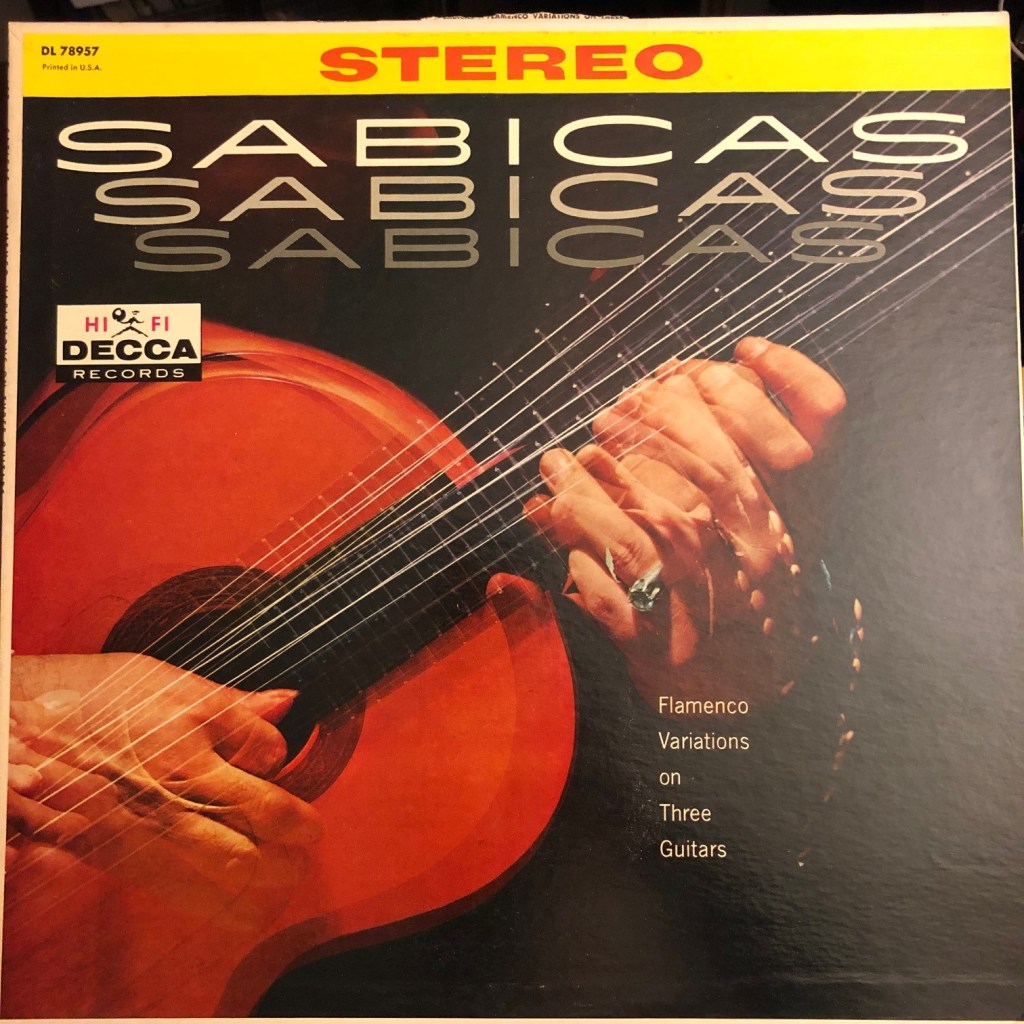
Sabicas – Flamenco Variations on Three Guitars from 1960. The album cover is pretty clever, right? An album review from the April 1960 issue of Billboard says the following:
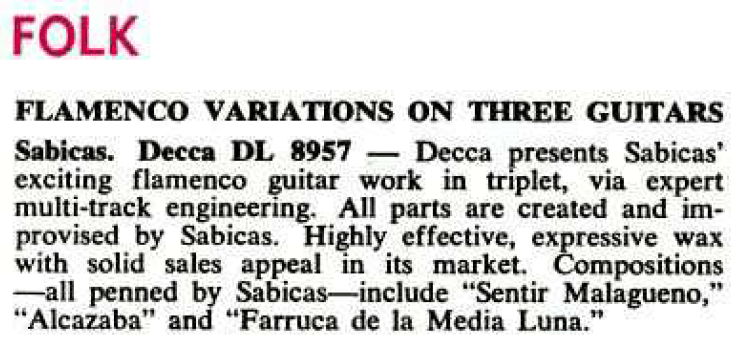
Should flamenco be categorized as folk…? If not, what should it be labelled as? Should music be categorized? I went to far… Let’s just say, three guitars playing tremolo sounds amazing, and it is great to see it was a guitarist who made a trio recording with himself?

(See the April 1960 issue of Billboard here, and see another post about a few things I found interesting from the same issue here.)

And allow me to digress – the solo guitar album Ole, La Mano!, by Juan Serrano:

I just find it funny that these two flamenco albums have the same color scheme and overlay image… The Sabicas album was released by Decca, and the Serrano released by Elektra. Was there a consensus for flamenco album covers?

After the Sabicas “trio” album, Conversations with Myself by Bill Evans from 1963 “followed”:
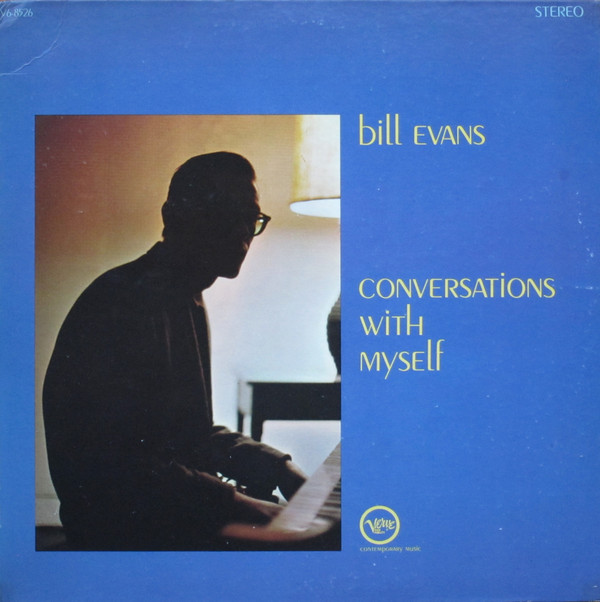
Like the Sabicas album, this is also a “trio” album, with Evans overdubbing two tracks over himself. Sure… while you were in the studio, why not? Evans would later release two more albums with self-overdubs: Further Conversations with Myself (1967) and New Conversations (1978).

Another guitar album came in 1966: Music for Two Guitars/Music for One Guitar by Rey de la Torre (released by Epic Records):

My friend Anthony LaLena told me about this album. I was so glad to know yet another “all-by-myself” album made by a guitarist. This album has a very long descriptive (but not very poetic) title, because one side 1 of the album contains three duet pieces, and side 2 has the solo pieces. Must Spanish guitar albums all share the same color scheme and “repetition” aesthetics for their covers?

The aforementioned Wagner arrangement by Glenn Gould came from the 1973 album Glenn Gould Plays His Own Transcriptions of Wagner Orchestral Showpieces:

Jimmy Raney album, Solo, from 1976 is the last “self-duo” album I would like to mention:
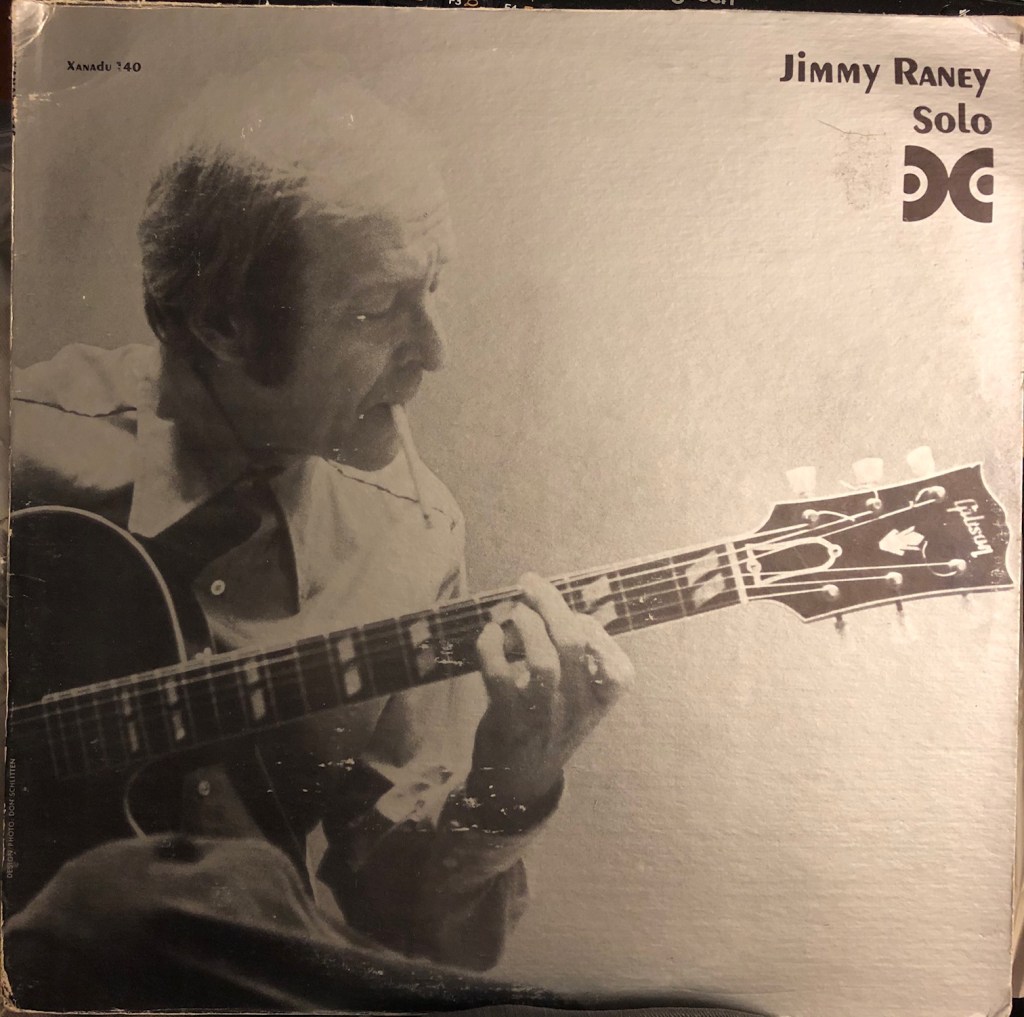
This album has the best title…! The back cover explains the rationale:

Bonus: this one is not really a full recording. It’s a video of Julian Bream (RIP) playing Luigi Boccherini’s Fandango with himself. Musicality aside, it is very dramatic – two Breams in suits of contrasting colors, throwing dirty looks at each other, as if they were in a competition, trading licks and trying to out play their opponents. The footage comes from the documentary, ¡Guitarra! from 1985.

#31 How it all started – 6

I eventually got my first acoustic guitar as my 16-year-old birthday present at 新星堂, a Japanese music chain that had a store in Hong Kong – Japanese rock was really popular back then, and Japanese culture is pervasive in Hong Kong. I drew a John Lennon self-portrait on this dreadnought-style guitar. I grew up watching the Beatles Anthology – when it was first broadcasted on TV, then re-watching the series numerous times as I have recorded it on VHS. Forward a few years, when I came to the States, I lent this guitar to a friend – we played in the same band, and I thought it would be easy to get the guitar back in the future. I never saw it again.
Beyond was a legendary band from Hong Kong, and I spent much time and effort learning songs on their double live album “Beyond 的精彩LIVE&BASIC“. It was a very emotional album, as it was the first live show after the passing of the frontman man, Wong Ka-Kui. I spent a lot of time learning the solo of 太空 and Love. I had the VCDs of the concert, and I just keep rewinding until I got the solos.

(The VCD is a “weaker” version of the DVD – lower resolution, and each disc can only store video of about an hour long. It’s a transitional format between VHS and DVD. I don’t think the VCDs were ever used in the US)

Back then, I didn’t know the opening track of the concert was an arrangement of Stravinsky’s Firebird! Well (I still don’t know about a lot of things)! As I started learning these songs, I quickly realized that there was such a thing as a cutaway guitar, and mine was not a cutaway. It was hard to learn those electric guitar solos.

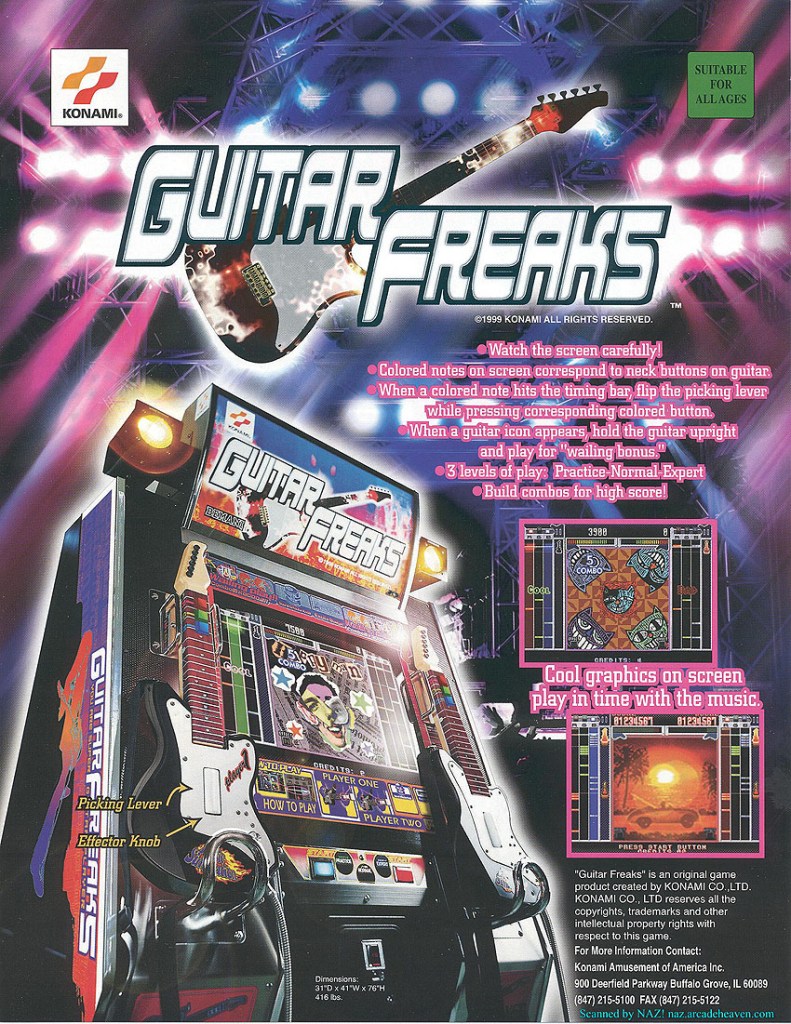
I picked up many loose melodies and licks here and there. I also learned 愛我別走, and 我的知己在街頭 (now, I would ask my more advanced guitar students to learn the latter). I remember making tabs of 愛我別走 in class. I was improving, and could learn melodies by ear faster. There was also the Japanese arcade game, Guitar Freaks (precursor of Guitar Hero in US). My friends would be playing Happy Man in the game, and I would be playing the same tune on a real guitar. At the time, the most difficult song I was learning at the time was Eric Johnson’s Song for Life.

A friend in 5C and I made a pact – we would go buy electric guitars together to start a band. We went back to 新星堂 on their annual “sale day”, waited in the long line, and bought the cheapest guitars in store. But I actually bought a bass. Yeah, if we start a band, someone had to play bass, right?

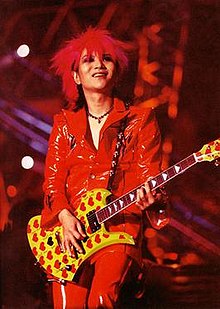
My friend ended up not playing his electric guitar much, and I borrowed his electric guitar too. Now I have an acoustic guitar, and electric guitar, a bass, and the J-rock band scores. Naturally, I was learning more, and really wanted a nice electric guitar. I was a huge fan of X-Japan, and was dreaming of Hide’s guitar. I would ended up getting something quite different.

Hide, and my dream guitar

(To be continued in How it at started #7)

#30 Jean François Salomon, the harpolyre, guitar playing and singing

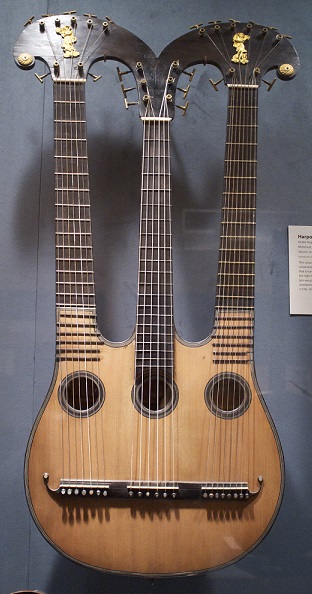
(Picture: Harpo-lyre (ca.1830), André Augustin Chevrier, The Met, NYC)

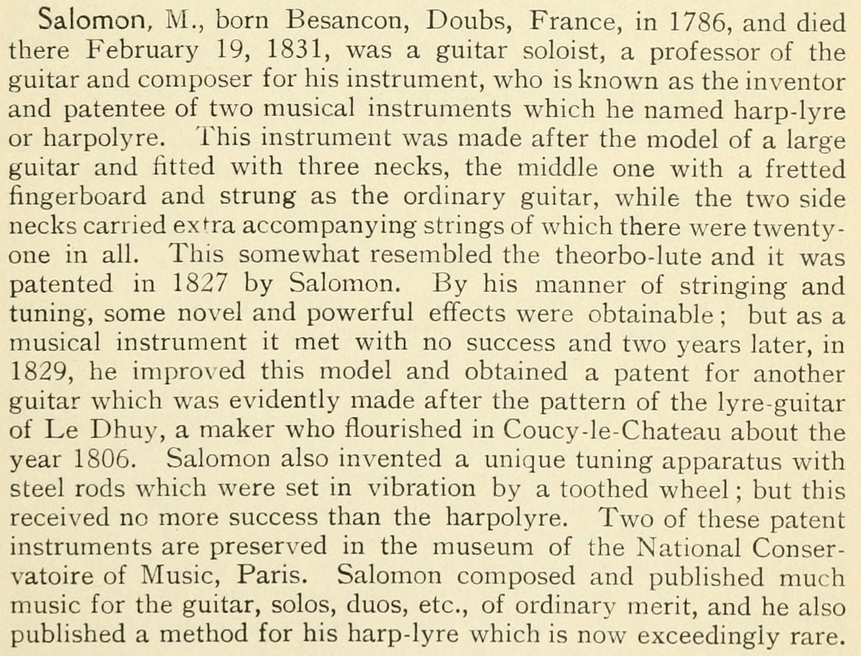
The following entry of Jean Francois Salomon is taken from François-Joseph Fétis’s Biographie universelle des musiciens (see the original on p.387 of the this PDF). This is translated with the help of the trusty Google Translate, so… please pardon my French. I have also attached Salomon’s entry in Philip J. Bone’s The guitar and mandolin: biographies of celebrated players and composers for these instruments. It looks like Bone translated Fétis’s entry, with slightly more information.

I wish I had a chance to play a harpolyre, and read Salomon’s method book. Where can I find them?

The harpolyre was introduced to London in the Harmonicon in December 1829. The article borne the subtitle that indicated Salomon as a “Professor of singing and of the Guitar”.

This led me to think – it’s obvious that the guitar (or many pluck string instruments throughout history) is a popular instrument because of its power to accompany singing. Wouldn’t it be nice if I can teach guitar and singing at the same time? Start advertising my lessons to be guitar lessons, plus guitar and singing combined lessons?

Many guitarists had a close connection with singer:

  • Sor was a choir boy, and later taught singing in London (Fernando Sor – Composer and Guitarist, Brian Jeffery, p.14);
  • Mauro Giuliani’s son Michele Giuliani was “the guitarist, composer, and singing teacher at the Paris Conservatory (see here);
  • Matteo Bevilacqua “moved to Vienna where he established himself as a singer, flautist, guitarist, and composer”, and he “he was a tenor at the Esterházy chapel” (Soundboard, Volume XXXVIII, No. 4, 2012, p.102 and 116)
  • Legnani’s debut as an operatic tenor was in Ravenna in 1807 at the age of 17, and had a singing career that spanned 17 years (see here);
  • Carulli published L’Harmonie appliquée à la Guitare (Harmony applied to the Guitar) and Solfèges avec accompagnement de guitare, Op.195 – two treatises that provided concepts and exercises to educate singers and guitarists about harmonies, accompaniment, and arrangement; Carulli also taught his son Gustavo guitar playing and singing, and his son went on to be a successful vocal teacher;
  • Ferdinand Pelzer, apart from teaching his daughters Catharina (better known as Madame Sidney Pratten) and Giulia Pelzer the guitar, published Music for the People, based on his Universal System of Instruction in Music and revolutionized the national system of singing and music in England (see theguitar-blog.com).

I have benefited from singing in a choir as a kid for four years myself, as it allows me to sing backup vocals in my bands with ease. My guitar teacher, Dr. Nicholas Goluses would often times ask me to sing the melody of the pieces I was working on, to explore interpretive possibilities.

From his Rules & Maxims for Young Musicians, Robert Schumann said,

“Love your instrument, but do not vainly suppose it the highest and only one. Remember that there are others equally fine. Remember also, that there are singers; and that the highest expression possible to music, is reached by chorus and orchestra.”

“A great deal is to be learned from singers and songstresses. But do not believe everything they tell you.”

“Sing in choruses industriously, especially the middle voices. This will make you a good reader, and intelligent as a musician.”


From François-Joseph Fétis’s Biographie universelle des musiciens:

Salomon (M.), guitar teacher, born in Besançon, in 1786, died in the same city, on February 19, 1831, became known, in 1828, by the invention of a three-neck guitar called Harpolyre , this instrument was mounted with twenty-one strings; six of these strings were placed on the center of the middle, called the ordinary neck, and tuned as on the common guitar. The left neck, intended for the basses, was mounted by seven strings tuned in semitones, from the low E to the bass of the double bass; finally the right handle, called the diatonic handle, was mounted with strings sounding C, D, E, F, G, A, B, C. Sound oppositions of good effect were noted between the middle and right necks, and the strings on the left neck provided vigorous bass notes. The conception of the harpolyre seemed destined to save the guitar from the entire abandonment with which it is threatened, by the varied resources which it offered to the performers; however, this invention was not successful, no artist having wished to devote himself to the study of the difficulties of the use of the three necks, although Solomon had had a method engraved for the harpolyre, and that Sor was composed studies and exercises for this instrument.

We owe Solomon the invention of an ingenious machine to which he gave the name of tuner. It consists of a mechanism made up of sonorous metallic blades, tuned to the degrees of the chromatic scale, and of a toothed cylinder, moved by a clockwork movement, which makes each blade resonate at will, giving a determined intonation. This intonation is repeated for as long as necessary to tune in unison a note of the piano, harp, or any other fixed-sounding instrument which is to be partitioned. In spite of the advantages which the tuner presented for the practice of the tuning of the instruments, it does not succeed only with the harpolyre. After having had an unnecessary long stay in Paris to have his inventions adopted there, Salomon returned to Besançon, where the fatigue of his efforts, and the sorrow of having dissipated in trials the fruit of his labors and his savings, the led to the tomb at the age of forty-five. One engraved of its composition: 1 Twelve divertissementsfor the guitar, op. 1; Paris, Launer. 2 Waltzes for the Guitar, Op. 2; ibid. 3 Contredanses and waltzes idem; Paris, Aulagnier. 4 Air varie (Charmant ruisseau) for the harp; Paris, Janet.


From The guitar and mandolin : biographies of celebrated players and composers for these instruments, p.261, by Philip J. Bone:

#29 Pasquale Taraffo

In the process of figuring out who was the “Paganin of the guitar“, I came across the Italian guitarist Pasquale Taraffo (1887-1937). I am always skeptical of what were the criteria for a guitarist to be called the Paganini of the guitar. Apart from his virtuosity, Taraffo shared at least two more things with Paganini – both of them were scorpios born in the city of Genoa (Paganini was born on 10/27, and Taraffo on 11/14).

There is a section dedicated Taraffo on harpguitars.net, with many pictures of Taraffo and his 14-string harp guitar. On Youtube, there is a video of Taraffo playing his own composition, Stefania. There is also a fascinating documentary that illustrates the life and techniques of Taraffo.

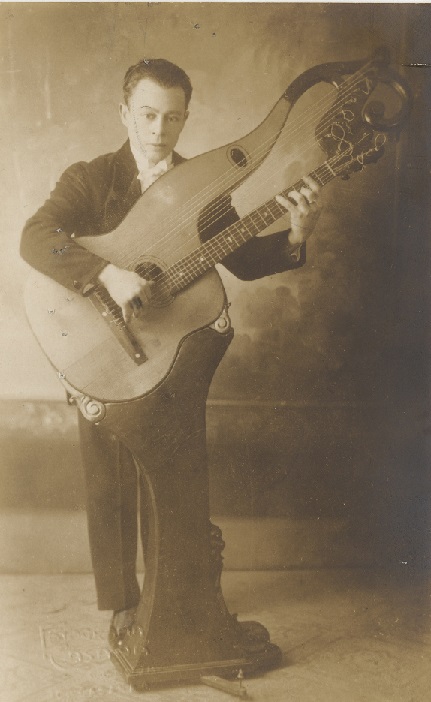
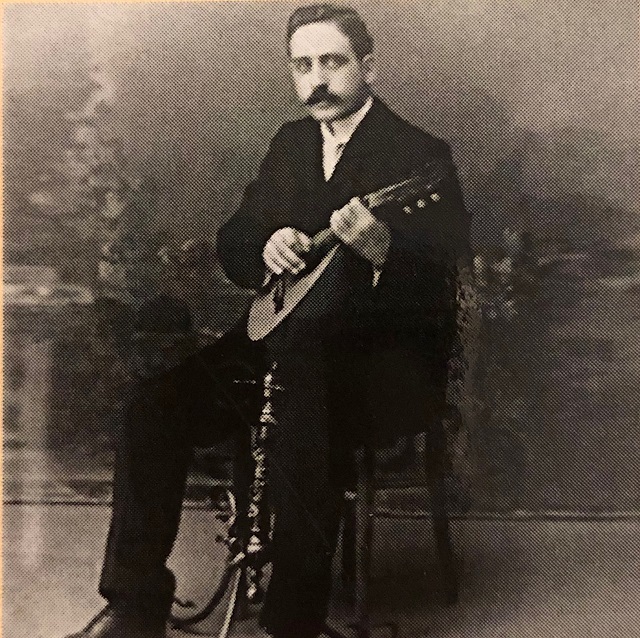
The pictures/images show Taraffo rested his harp guitar on a pedestal as he played. This reminded me of Aguado’s tripodison, which is “a device intended to maintain the guitar in a fixed position for easy playing, and for increasing its volume as far as possible” (From Aguado’s New Guitar Method, p.6). In the Secrets of Taraffo, Greg Minor mentioned the pedestal allows the back of the guitar to resonate freely, which is the same reason Aguado advocated the use the tripodison. Minor also mentioned the hollow pedestal might act as a resonator.

Aguado with his guitar on the tripodison.

Taraffo’s pedestal does look a lot “safer” to use – once placed on the pedestal, the harp guitar is secured and can stand without any support. I always wonder if the guitar would stand on Aguado’s tripodison on its own – the angle looks pretty steep…? At least, Aguado’s tripodison can be easily transported – “these three legs and the entire device when taken apart can be folded up and put in the same case as the guitar” (Aguado, New Guitar Method, p.7, footnote 4).

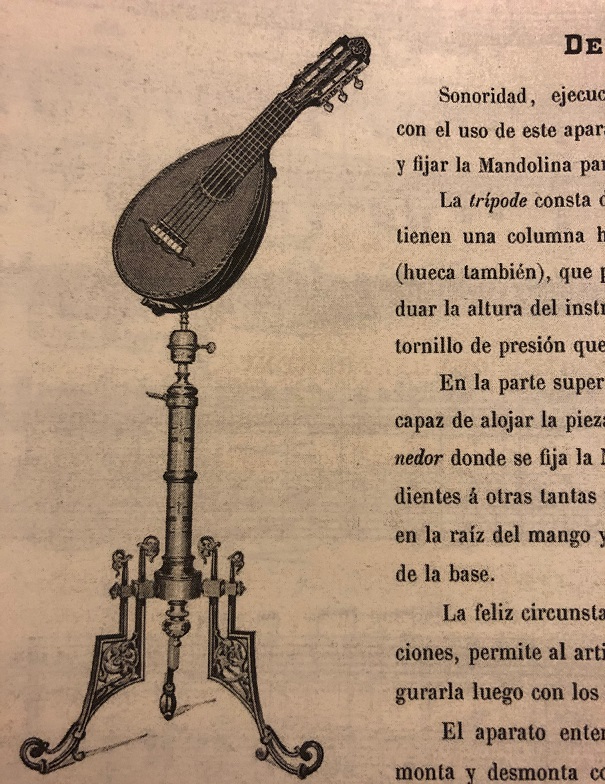
And speaking of instrument support, I can’t help to mention what I saw from a new score I bought – a support for the mandolin:

These pictures were taken from the newly published Miguel Llobet – Works, volume 15, with works arranged and composed for Lira Orfeo, a pluck string ensemble in Barcelona between 1898-1907, with Francisco Tárrega as the honorary president, and Miguel Llobet the de facto president, arranger, and conductor. More on this in a later post.

The combination of a harp guitar on a hollow pedestal also reminded me of the harpolyre: an instrument from the 19th century, with 21-string instrument and 3 necks.

The above is the cover of The Lost Music of Fernando Sor, which contains Sor’s output for the harpolyre (6 Petites pièces progressives, a funeral march, and Trois Pieces) transcribed for guitar by John Doan. The harpolyre was an invention by Jean François Salomon in 1829, in an attempt to create a loud guitar. In addition to having a bigger body and extra strings for sympathetic vibration, there are also two metal rods connecting the instrument to an amplifier podium…!

Apart from Sor, François de Fossa wrote music for the instrument (6 Divertissements for harpolyre op.21), and Carcassi was supposed to have composed music for it too. The Harmonicon from December 1829 gave a detailed description of the construction of the harpolyre). Sadly, Salomon ran out of funds in 1831, died in the same year, and the harpolyre was forgotten. (See Salomon’s entry in François-Joseph Fétis’sBiographie universelle des musiciens here.)

For more information on the harpolyre, check out The Lost Music of Fernando Sor – Complete Works for Harpolyre Transcribed for Guitar, theharpguitars.net, and earlyromanticguitar.com.

Back to Taraffo… What fascinates me the most about Taraffo was his tremolo techniques, which were all explained in the documentary on Youtube. Apart from the standard p-a-m-i tremolo, he would use the

1) “ring finger as a plecture”

2) “quardruplet tremolo with chords”

3) “sextuplet tremolo with chords”

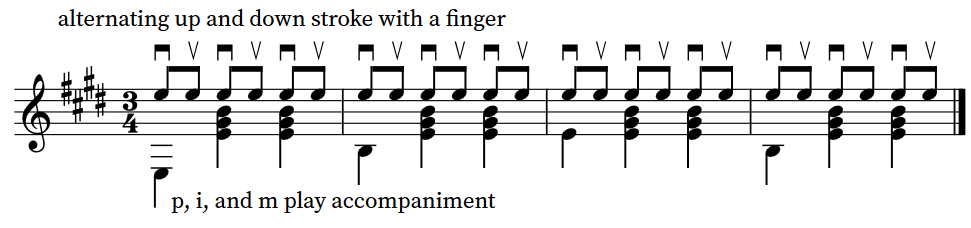
Another cool technique Taraffo used was the “rasgueado on two or more strings”. Unlike the rasgueado used in the flamenco tradition, where the player would strum multiple strings with the back of their nails, Taraffo would maintain the normal plucking motion, but pluck through the top two or three strings at the same time:

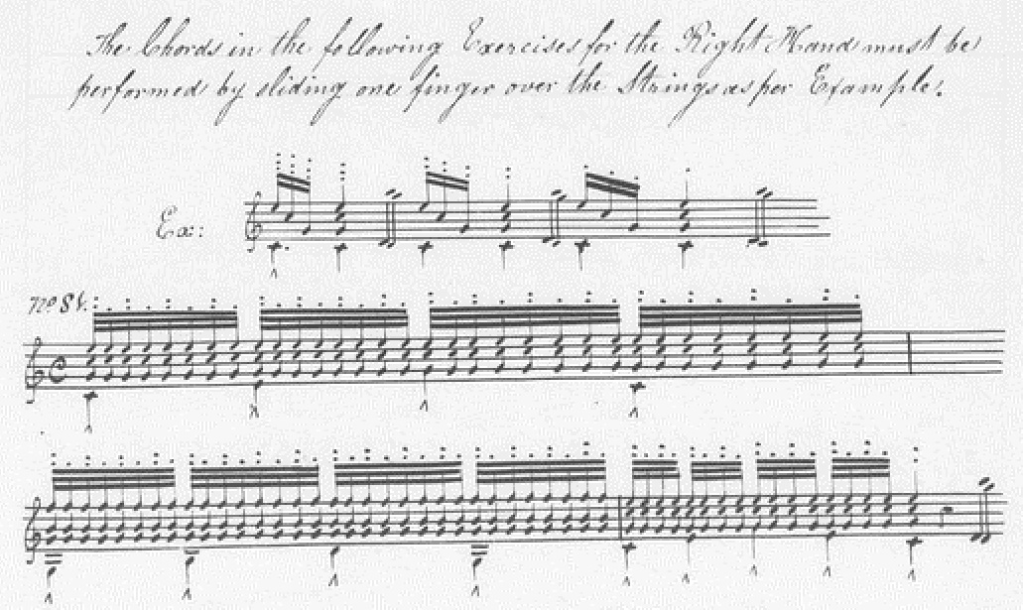
This last rasqueado technique allows for a very controlled and less aggressive strumming sound compared to the flamenco rasqueado. Taraffo’s Stefania is the first guitar piece I know that utilized this technique, even though I have seen this technique being discussed by my friend Daniel Nistico – he saw it from a 19th century source – it is one of the 150 exercises presented by Ferdinand Pelzer (father of Madame Sidney Pratten) in 1836:

three dots = a finger, two dots = m, one dot = i. this exericse does not involve the a finger.

Check out this video of Daniel going through this exercise, and his site for an introduction of the 150 exercises by Pelzer.

Wikipedia included the known repertoire of Taraffo, which contained (only) two classical guitar pieces – Capricho Arabe by Francisco Tarrega, and Fantasia Capriccio by José Viñas. His repertoire also included many original compositions (I can’t wait to go check out the CD from Sibley Music Library) and arrangements from operas. I will end with a video recommend to me by my friend Orphée Russell – Taraffo’s arrangement of Cavalleria Rusticana, transcribed by Christian Saggese, from Taraffo’s recording.

#28 Berlioz, La guitare

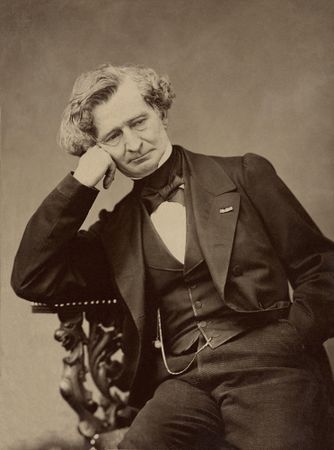
(The Berlioz picture looks a bit like this Schumann picture?)

In my previous post, I wrote about the French music critic François-Joseph Fétis disliked the guitar as an instrument. As a contemporary to Fétis, Hector Berlioz also wrote about the guitar in his Treatise on Instrumentation and Modern Orchestration (1843-1844). There was bad blood between this pair of French music critics (see their disputes on Wikipedia), and it’s interesting to see Fétis and Berlioz held different views even on the guitar (I don’t think that’s actually a point of their argument). As a guitarist himself (see this article with conflicting accounts of Berlioz’s guitar chops), Berlioz gave a fair presentation of the guitar in his treatise.

(I was reading the 1882 English edition by Novello, Ewer & Co., and the guitar section begins on p.66 of the PDF. The table of content is at the end of the book).

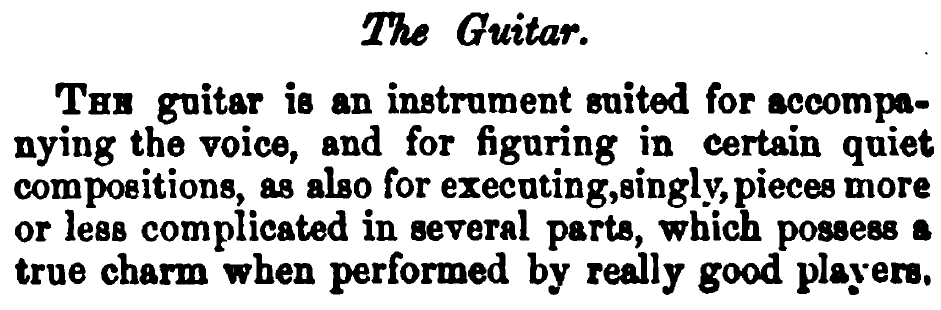
Berlioz’s entry on the guitar is not unlike an abridged-method that explains the basics of the guitar without any exercises: tunings, basic right hand pattern, simple chord progressions, arpeggio patterns, thirds, repeated notes, and harmonics. The guitar entry begins with:

Berlioz tells the reader upfront what the guitar does best. Maybe Mahler read Berlioz’s entry and incorporated the guitar and mandolin for some “figuring” in his 7th Symphony? I certainly wish Mozart had included an actual guitar in his aria Voi che sapete from the Marriage of Figaro, instead of having someone lip-synching to the “guitar accompaniment” performed by the pizzacato strings.

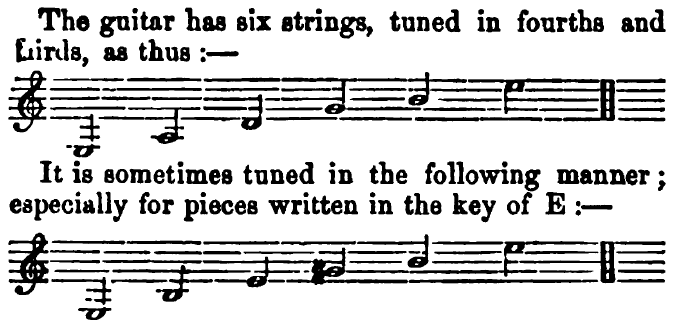
The entry continues to the tuning of the guitar:

It was really curious to see Berlioz mentioned about the open E tuning as a possible tuning. Open tunings on the guitar seem to carry an association with the Hawaiian slack key tradition, folk music, and blues, but I have encountered quite a few pieces and methods that mentioned and employed opening tunings – open D, open E, open G, open A, and open C – in the classical guitar literature. For instance, from an advertisement (see the last page of this PDF), Madame Sidney Pratten apparently had An Instruction for the Guitar Tuned in E major, along with an long list of compositions for open E tuning. But… I digress. More on open tunings for classical guitar in a few future posts.

On right hand position for accompaniment:

“…the little finger resting on upon the body of the instrument” – the Sor/Carcassi/lute approach which was common in the 19th century.

The entry continues with keys and progressions that does not require “the use of barrage” (what a nice word). These key choices and chord voicings revealed a few things:

C major: later in the entry, Berlioz mentioned the it is difficult for non-guitarist to compose for the guitar, and suggested one to study pieces of celebrated guitarists, included those of Sor. Berlioz might not have studied Sor though, as Sor would not have allowed the parallel octaves to happen (even if the parallels are in the inner voices?). Also, many of these chord voicings seem a bit thick – chords with a minimum of 5 notes? Did Berlioz really use the voicing circled in green?

D major: was Berlioz a “Carullist” who would use his left hand thumb for the D chords (circled in green)? Also, what Berlioz marked “difficult” are indeed not the most convenient for the fingers.

A major: I actually liked the ii6/5 voicing. I am surprised he didn’t add a low A to this chord to make it sound thinker. The vi chord circled in blue is another possible “Carullist” voicing. And did Berlioz really mean to end this progression with a first inversion chord?

E major: this progression seems to make most sense. The pedal point in the opening is a nice touch.

F major: more “Carullist” chords (in green)? The “difficult” chord doubled chordal 7th and in turn led to parallel octaves. And toward the end, Berlioz ceased to use the thick voicings – due to the barrage?

And this is also interesting:

I like how Berlioz suggested adding the low open A to the E diminished 7th chord (circled in red) to comply with his principle of not skipping the “second” string (did they refer to the fifth string as the second string back then?). Let’s just add a non-chord tone (A) to the E fully diminished 7th chord – easier to play, more tension!

Berlioz continues to discuss avoiding close position dominant 7th chords, except for the F#7 (circled in red):

Did Berlioz have the famous Sor etude (Segovia’s #5) in mind?

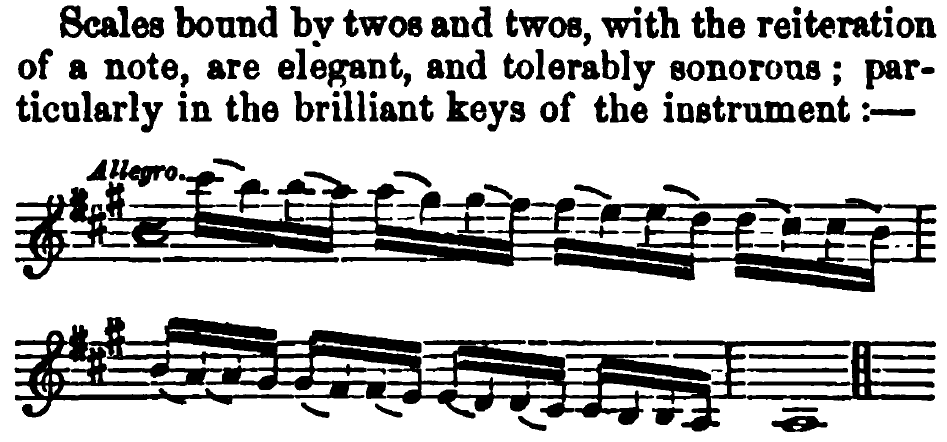
After discussing common right hand arpeggios, Berlioz talks about scales:

“Twos and twos” – maybe Berlioz played with nails, and the slurs made scales less “clicky”?

In regards to “reiterations (roulements)”:

The lack of right hand ring finger usage is in line with the practice of the time – the little finger rests upon the soundboard, so the movement of the ring finger is restricted, especially for playing rapid repeated notes. It shows a p-i-m-i tremolo pattern – not the p-a-m-i pattern used today (see my post on tremolo.)

Berlioz mentioned a few celebrated players of the time (1843-44): “Zanni [sic] de Ferranti, Huerta, Sor, & c.”. Compare that to guitarists mentioned by Fétis in his Music Explained to the World: Or, How to Understand Music and Enjoy Its Performance from 1830: Carulli, Sor, Carcassi, Huerta, and Aguado. We can see that Carulli was gone, with Ferranti making the list, and the poor Aguado became “&c.” by playing duets with Sor.

Berlioz concluded his entry of guitar with two remarks. The first of which is:

I have heard guitarists said that the 19th century guitar repertoire was not in line with the 19th century music repertoire – no significant composers wrote for the guitar, and our best works, say, a Sor sonata, lack the depth of, say, a Beethoven piano sonata. Maybe Berlioz’s remarks here makes a good defense for the guitar? Each instrument is unique, and no other instrument can replace the charm of the guitar. And maybe we have more guitar virtuosos than ever who can literally perform ANY piece on the face of the earth?

Berlioz last remarks in the guitar entry of the treatise:

How did Berlioz find out about this? Were there guitar orchestras back then? Maybe Berlioz taught some after-school group guitar class…? I must admit a guitar ensemble does not appeal to me. Guitar duos and guitar trios, on the contrary, are very efficient mediums. Duos/trios that are really in sync would sound like only one instrument is being played, with the full spectrum of frequencies being utilized in the same composition – maybe resembling a “four-hand” or “six-hand-one guitar”?

#27 Fétis, from Paris without love

For many years, I have learned that Fernando Sor was called “the Beethoven of the guitar”. I was always perplexed as to what is the connection between the two composers. Who made that claim?

Quite a few websites mentioned it was François-Joseph Fétis, a famous 19th century music critic, who made such a claim. No one really pointed out in which publication did Fétis make this reference though. So I started looking up writings of Fétis, and came across a translation of his book, Music Explained to the World: Or, How to Understand Music and Enjoy Its Performance from 1830 (the translation published in 1844).

Fétis’s book discussed a lot of instruments, and I went straight to the sections regarding the plucked string instruments: the lute (p.110), the archilute and the theorbo (p.111), the mandore and pandore (p.111-112), the mandolin (and its obscure relative calascione, on p.112), and the guitar (p.113-114). He wrote:

“The guitar appears to have originated in Spain, though it is found in some parts of Africa. It has been known in France since the eleventh century, at which time it had the name of guiterne. It is almost the only one of all the stringed instruments played by snapping, and with fingerboards, which remains in use. The body of the guitar is flat on both sides, it is furnished with six strings, and its fingerboard is divided by frets for the placing of the fingers. In France, Germay, and England, the art of playing upon the guitar is carried to a very high point of perfection. In these later times, Sor Aguado, Huerta, and Carcassi, have made it a concerto instrument, and have succeeded in executing upon it very complicated music, in several parts; but, in Spain, the native country of this instrument, it is used only to accompany the boleros, tirannas, and the other national airs, and the performers play upon it instinctively, by striking the strings, or rattling them with the back of the hand.” (p.113)

Pretty cool to see Fétis mentioning the superstars of the Paris scene around 1830s? Also, the use of rasgueado seemed to be getting a bad rep early on in the 19th century.

In a later section of the book, Fétis wrote:

“The limited resources of the guitar are well known. It seems calculated only to sustain the voice lightly in little vocal pieces, such as romances, couplets, boleros, etc. Some artists, however, have not limited themselves to this small merit, but have sought to overcome the disadvantages of a meagre tone, the difficulties of the finering, and the narrow compass of this instrument. Mr. Carulli was the first who undertook to perform difficult music on the guitar, and succeeded in it to such a degree as to excite astonishment. Sor, Carcassi, Huerta, and Aguado, have carried the art to a higher degree of perfection; and if it were possible for the guitar to take a place in music, properly so called, these artists would, doubtless, have effected that miracle; but to such a metamorphosis the obstacles are invincible.” (p.234)

Even though Fétis held Carulli in high regards and acknowledged Carulli as the “grandfather of the guitar” in the 1830s Paris scene, he bashed the guitar relentelessly…!

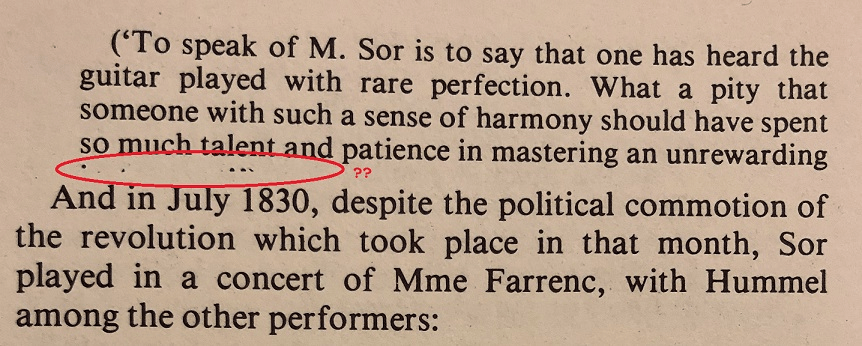
In the biography, Fernando Sor: Composer and Guitarist by Brian Jeffery, there are many accounts of how Fétis thought Sor had chosen the wrong instrument. For instance:

p.105, Fernando Sor- Composer and Guitarist, Brian Jeffery

The missing word there should be “instrument” (is it just my copy that missed the last word(s) of the paragraph?)

As usual, my original task was not solved, and the process opened many unexpected doors. Fétis’s account of the guitar reminded me of a similar entry by another French music critic, Heitor Berlioz (to be continued).

#26 First tremolo piece for classical guitar? – #2

My quest to look for the first guitar tremolo piece was not easy – I looked at a lot of scores and method books, but could draw no conclusion. I decided to examine a few guitar history books I own to see if any of them discussed about tremolo on the guitar, and sure enough I found exactly what I needed.

During my years in Indiana, I began taking private guitar lessons from Professor Julio Ribeiro Alves. It was Julio along with my parents who supported me to pursue a degree in guitar. Julio has written his own textbook on the history of guitar, and it is from his book that I found out about Antonio Cano (1811-1897):

“He was a pupil of Aguado, and his main addition to the guitar world was his Método de Guitarra, written in 1852. The method was reissued sixteen years later with an added harmony treatise adapted for the guitar. Although there is no real documentation, it is believed that he taught some lessons to Francisco Tárrega (1852-1909) and was influential in the development of the tremolo technique.”

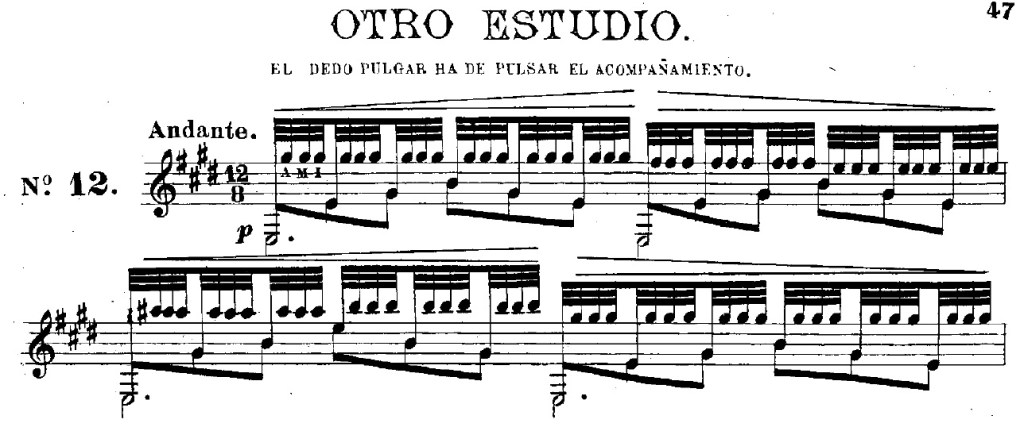
Cano’s method from 1852 does not cover the tremolo, but the very last piece from his Método Abreviado from 1892 is a tremolo study, with clear right hand fingering of p-a-m-i:

Tárrega composed Recuerdos de la Alhambra in 1896, so a method book from 1892 at least shows that the tremolo technique was established by late 19th century. If Cano’s methods from 1852 did not discuss no tremolo, so maybe we can assume the tremolo technique was established between 1852 to 1892?

Examining Cano’s method also made me realized that all the previous musical scores and methods I have examined, with the exception of Sor’s, were by non-Spanish guitarists – Carcassi, Giuliani, Legnani, Regondi, Mertz, Coste, and Pratten. So maybe the standard tremolo technique as we know now stemmed from a Spanish guitar tradition?

With some new directions, I focused on looking through music and method books by 19th century Spanish guitarists. It turns out that Cano has a tremolo piece – El Delirio – that is very close to the modern tremolo, except a p-m-i tremolo was used. But, looking up recordings of this piece, many modern guitarists would just play the p-a-m-i tremolo anyways.

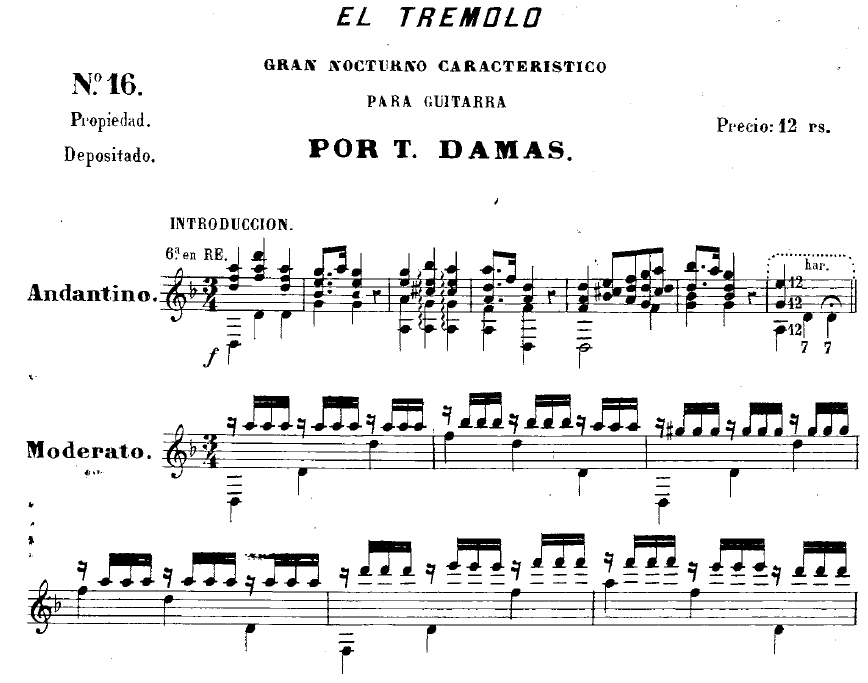
Exploring the connection between Cano and Tárrega, I came across a site dedicated to Tárrega, and it mentions Tomas Damas (ca.1817-1880), who wrote a tremolo piece called El Gran Tremolo (1872, score, video) – looks a bit like Cano’s El Delirio?

El Tremolo, as in a lot of other pieces, does not include right hand fingering. Damas’s Método completo y progresivo de guitarra (1867) does not discuss tremolo technique in particular, but the etude that closes the book (just like Cano’s Método Abreviado) has passage that looks like modern tremolo. But the problem remains – no right hand fingering. Damas’s Método de guitarra por cifra compaseada (1869), on the other hand, provides the answer I have been looking for – indicating a right-hand p-a-m-i fingering for an “exercise of repeated notes”:

Wait… this method is printed in tablature…? In addition, it’s not the modern tab – it is printed like Italian lute tablature, with the bottom line of the tab as the first string of the guitar.

(The year of publication of Tomas Damas’s works are taken from a recent Jstor article about the life and works Tomas Damas, with a complete catalog of Damas’s works. The only problem is that… I don’t read Spanish. It’s going to be a project to “read” the article through Google Translate…)

In search of more 19th century Spanish guitarists and music, I came across two volumes of 19th century Spanish guitar works, published in Berlin in 1926, as pointed out by my friend, a 19th century guitar buff, and fellow Eastman grad, Daniel Nistico. These volumes included quite a few pieces by José Viñas (1823-1888), two of which are tremolo pieces – Fantasie Original from volume 1, and Erinnerungen an Palma from volume 2. These two pieces are the last piece in their respective volumes. And I think I am seeing a pattern here – just like Cano and Damas, where they have included tremolo as the final study of their methods, tremolo is always placed last in a publication, as it is the ultimate technique for a classical guitarist to conquer (a slight pun intended for El Ultimo Tremolo)?

Erinnerungen an Palma is also subtitled “Recuerdos de Palma”. Tremolo and memories… did Tárrega know this piece? Well:

“This is the first collected edition of the guitar works of José Viñas (1823-1888) who was a multitalented musician and equally successful as violinist, pianist and guitarist, but he made most of his living as orchestra conductor. His home in Barcelona was a meeting point for guitarists and travelling virtuosos where Broca and Arcas played. Francisco Tárrega copied parts of Viñas pieces into his own works. Viñas “Fantasie original” has always been present in the guitarist s repertoire and here are many more rewarding works, from simple to demanding.” (taken from carlfischer.com)

“…copied parts of Vinas pieces into his own works”…? And this shed a lot of light on a very interesting discussion…

But I digressed… back to these German publications – they do include right hand tremolo fingersings: the familiar p-a-m-i, but I can’t be sure if they are editorial. In addition, the score of Fantasie Original found on IMSLP also contains right hand fingering, but the year of publication is unknown.

And may I digress again: Fantasie Original is subtitled “Capricho a imitacion de Piano”

Guitarists tried (and are still trying) to mimic and transcribe piano music, adding effects to make these transcriptions more “guitaristic”, but I can’t imagine the reverse – hearing the guitar tremolo on the piano. And apparently it has been done (with a-m-i-p in this video). Doesn’t sound too natural on the piano, does it? What about the violin? Accordion? Mandolin? Harp? Bass?

Anyway, check out Daniel’s excellent rendition of Viñas’s Fantasie Original here.

I don’t seem to be able to find tremolo pieces by José Brocá (1805-1882) and Antonio Jimenez Manjón (1866-1919). Jacque Bosch’s method (1890) contains music with three-finger p-m-i tremolo. The last Spanish guitarist/composer I would like to mention who have employed tremolo in his music is Julián Arcas (1832-1882).

Julián Arcas

As Adrian Rius mentioned in his biography on Tárrega:

“Some time during February and March of 1862, the eminent guitarist from Almeria, Julián Arcas, performed in Castellón. The effect the concert had on Tárrega was so intense he never managed to forget that night, even though he had not yet reached his tenth birthday. After listening to the acclaimed master, his father and various friends asked if this famous arist might listen to the little boy. Surprised at the skills displayed by that youngster, Arcas offered to direct him in his studies, suggesting that Tárrega be sent to Barcelona, where Arcas was living at that time. The idea was accepted by all concerned, with great joy and profound emotion on the part of his father.”

The young Tárrega did move to Barcelona, but ended up taking only a few lessons from Arcas. The p-a-m-i tremolo, however, can be found in Arcas’s Funeral March de Thalberg, Fantasia Sobre La Traviata, and El Delirio (as mentioned, Cano also has a tremolo piece called El Delirio. Tremolo makes people crazy?)

So maybe we can see the tremolo as a classical guitar technique that came from the Spanish tradition? Perhaps the young Tárrega heard tremolo in Arcas’s concert, learned about tremolo thourgh lessons with Arcas, and later Cano? Tárrega also defintely knew of Viñas’s Erinnerungen an Palma. And Tomas Damas included a tremolo study with p-a-m-i fingerings in his method from 1869 – meaning, it was a technique that might be widely used by that time.

There are still many questions to be answered, and I know I am missing a lot of information: for starters, years of publication for works by Arcas, Cano, and Viñas. I have only examined pieces by guitarists/composers I could think of, and I am sure there are many from the 19th century whose works and methods I have not examined. Furthermore, I could only examine scores and methods I owned, or I could found on the internet (mostly through IMSLP and Boije). And I could not speak much of the flamenco tradition, which also uses the tremolo technique (do flamenco guitarists use other tremolo fingerings other than p-i-a-m-i?), due to my lack of knowledge in the subject.

Roland Dyens has a tremolo piece that is wittily titied El Último Recuerdo. I thought to myself, if I were to ever compose a tremolo piece (or a piece at all), mine would be called El Recuerdo Delirio.

#25 The Paganini of guitar

The guitar in the picture: early romantic guitar (Paris around 1830) by Jean-Nicolas Grobert (1794-1869). Instrument top shows signatures of Paganini and Berlioz. The guitar was loaned to Paganini by Jean-Baptiste Vuillaume in 1838 and later given by Vuillaume to Berlioz, who later donated it to the Musée du Conservatoire de musique in 1866. Today the guitar is displayed at the Museum Cité de la Musique in Paris.

– from Wikipedia


I played this Fantasy afterwards for Guillieu of the Paris Conservatory and the first flute soloist of the Grand Opera, who said to me: “Is it possible that you have never had any lessons in composition or guitar playing!”

“Never,” said I.

“In this case.” he declared “you must have some rare musical ‘bump,’ and if you continue at the same rate you will some day become a Paganini of the guitar.”


The above is taken from the The Memoirs of Makaroff, written by the 19th century Russian guitar enthusiast, Nicolai Petrovich Makaroff (1810-1890), of his encounters of many classical guitarists. His story of having the potential to be “a Paganini of the guitar” is a bit… sad – Paganini was so highly esteemed, such that guitarists would be proud and worthy when they became a “Paganini of the guitar”. The guitar was such a lowly instrument in the 19th century (and maybe now?) that its worth had to be defined by another instrument.

To be honest, I am not really upset when a guitarist is labelled as a “Paganini”. All guitarists being called “the Paganini of Guitar” really deserved it. What I found funny is the number of guitarists that were assigned such honor: Mauro Giuliani, Trinidad Francisco Huerta y Caturla, Luigi, Legnani, Giulio Regondi, Antonio Jiménez Manjón, and Pasquale Taraffo. Agustin Barrios called himself “the Paganini of the guitar from the jungles of Paraguay“. There might be more. I just got lazy with the internet search. Everyone needed a marketing claim, and it doesn’t matter that everyone used the same one. It just had to be a good one.

Quite a few discussions on the internet actually mentioned Paganini was the real Paganini of guitar, as he was a fine guitarist himself and the guitar was the constant companion in all his travels. I remember checking out the complete works for solo guitar of Paganini from the Sibley Music Library and playing through the three volumes. I love these pieces – sonatas, ghiribizzi, and a various assortment of pieces. All of them are short, with a few arrangements of opera tunes.

From the intro section of the Complete Works for Solo Guitar: The 43 Ghiribizzis (“whims” or “fancies”) are delightful miniatures in the mould of childrens’ literature… in another letter (January 7, 1824) he writes: “The guitar Ghiribizzi were composed for a little girl in Naples, I did not want to compose but more to scribble; but some of the themes are not unappealing and to pass the time, if you have a copy, you would not do badly to show them to Sig. Botto’s charming daughter”.

(More info on these pieces here)

Paganini’s solo guitar works are very enjoyable. The compositions are quite “straight forward” – they seem easy to play. But the way Pavel Steidl played these “simple” pieces completely changed my world – the way he phrased, the subtlty and drama he portrayed, and all the added ornaments. Maybe he should be called the Paganini of guitar, as he unveiled to me how Paganini conceived his guitar music?

#24 The failed hip hop DJ

A birthday card from IU, celebrating my 21st, and reminding me to act wisely.

The legal drinking age in Hong Kong is 18, so it felt quite strange that I was not allowed to drink when I came to the States at 19. It didn’t matter too much though, as I am not a heavy drinker anyways. But turning 21 was still a happy event, because I started going out a lot more to see live shows at different bars and venues. I was really into hip hop at the time, and I still remember seeing performances of DJ Mike Relm, Yuri Lane, and Del the Funky Homosapien. It sounds a bit “wrong”, but I took a class on hip hop offered by the anthropology department. I ended up writing my final paper about bboys in Bloomington.

Although rap might be the most direct link to hip hop for most people, it seemed so distant to me. Writing good Chinese was already tough, and I couldn’t imagine how would I ever be able to write cool lines and rhymes in English, let alone rapping with a flow. No talent in visual arts either, so grafitti was out too. Break dance was too physical. Dj-ing, on the other hand, was enticing: sampling is economic (create new music from the old) and efficient (picking out the coolest/catchiest/most groovy part of a record); beat juggling and scratching just sounded so cool; and a DJ must know a lot of songs (always in search of the most unique/obscure record and breaks that no one else have heard).

I can’t remember what year it was (2009?), but not knowing what to expect, I went to the DMC World DJ Championship in Chicago and saw C2C. I started making a few DJ friends, mostly moving records and equipment for them at parties. I quickly learned that being a DJ would be quite impossible too, because I could not afford the gear and the constant need of acquiring new records (most DJs probably don’t mix vinyls, but a vinyl DJ is still my ideal of a “real DJ” to this day). I still started buying records anyways, thinking they might become useful some day.

The coolest thing I learned from this period was The 45 King, who mixes 45s! And naturally so I started buying lots and lots of RnB 45s on ebay. As I seriously began my classical guitar studies, I put my DJ dream aside, and slowly forgot about these 45s…

Last year, a good friend of mine asked to see my 45 collection. She got into Djing, and started doing her own shows. She would like to see if there were any 45s she could borrow for one of her upcoming shows. We started digging through these forgotten discs, which included many Motown, soul, disco, and RnB tunes. But embbeded in the collection was a small stack of Ranchera records that I didn’t even realize were part of the collection. I must have not paid attention to them back then, since they were not something I could use for a hip hop set (or maybe I could have?). We put these records on, and they were just THE BEST MUSIC. I wish I understand Spanish to know the songs even better, but one can feel the passion and emotions even if you were listening to the expressions of the singers alone.

My purchase of 45s has since then been resumed, and mostly ranchera produced by Bego Records! (oh well, with some reggae and dancehall too) When things get back to normal, I hope to ask my Dj friend to spin these Ranchera records, maybe at a local Mexician restaurant, and maybe a benefit show of some sort?

#23 A brief chat with Hector about the mandolin

xxxxxxxxxxxxxxxxxxxxxxxxxxxxxxxxxxxxxxxxxxxxxxxxxxxxxxxxxxx

(K was led to see B in his study room. K was reminded that B might just kick him right out. They knocked on the door, and greeted B courteously. Disturbed from his work, B stood up and walked toward the table for water and snacks.)

B: Let’s get started. I don’t have a lot of time.

K: Certainly. So… I know the guitar is your main instrument. You gave, lessons, composed solos (variations on Mozart’s La ci darem la mano), and songs. What do you think of its relative in the pluck string family, the mandolin?

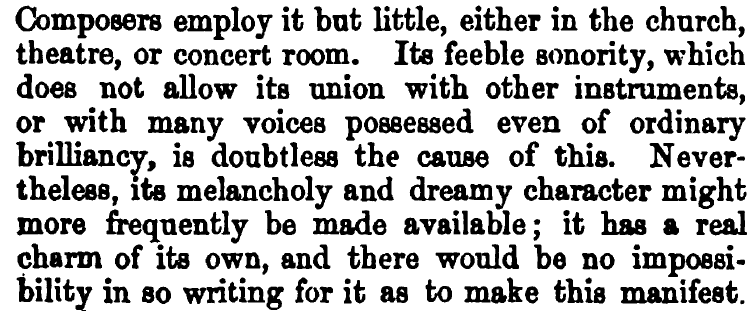
B: The mandolin has almost fallen into disuse at present; and this is a pity, for its quality of tone – thin and nasal though it be – has something piquant and original about it which might occasionally be made of effective use.

K: You seem to know a lot about the mandolin?

B: There are several kinds of mandolins; the best known has four double strings; that is to say, four times two strings in unison, and tuned in fifths, like the violin. It is written for on the G clef: –

(B took a small bite of his snack, and continued)

B: The E strings are of catguy; the A strings, of steel; the D strings, of copper; and the G strings, of cargut covered with silver wire. The compass of the mandolin is about three octaves: –

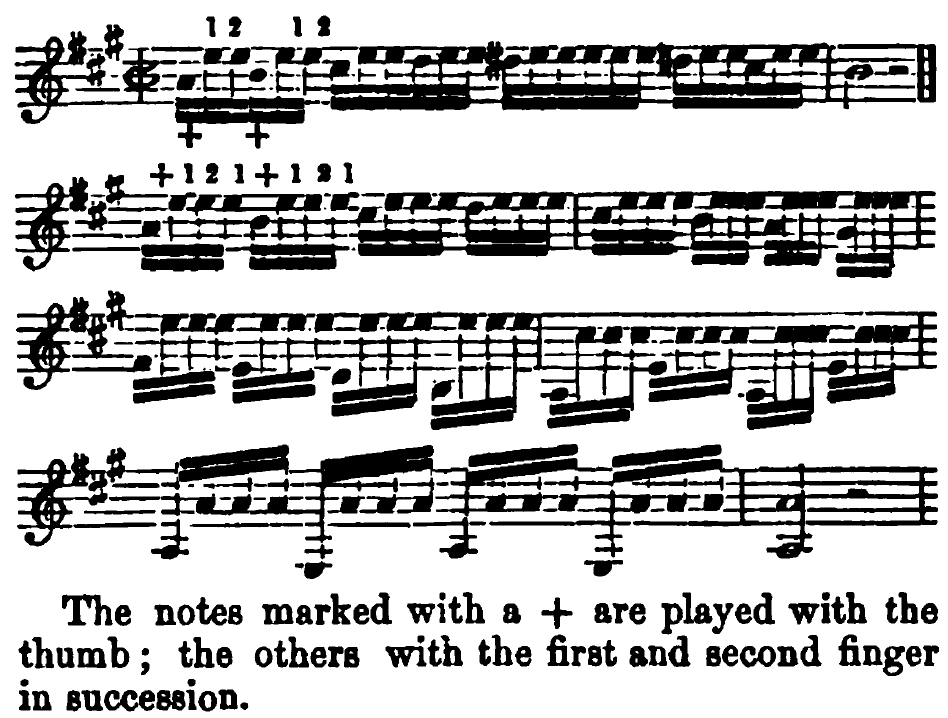
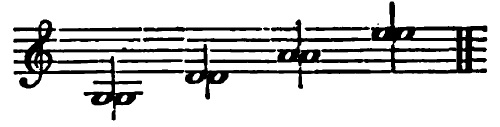
It is an instrument more for melody than for harmony; though its strings, being put in vibration with a quill or plectrum, which the player holds in the left hand, may certainly allow chords of four notes to be heard, such as these –

which are obtained by passing the quill rapidly over the four double notes; but the effect of these groups of simultaneous notes is rather poor, and the mandolin has its real character and effect only in such melodious accompaniments as the one written by Mozart in the second act of Don Giovanni: –

K: I cannot agree more. Just like his simple yet delightful setting of Komm, liebe Zither komm.

(B sat down, took another snack before continuing the conversation.)

B: The mandolin is at present so neglected, that, in theatres where Don Giovanni is played, there is always a difficulty in performing this serenade piece. Although a few days’ study would enable a guitar-player, or even an ordinary violin-player, to acquire sufficient knowledge of the mandolin for the purpose, so little respect is entertained for the intentions of the great masters, whenever it is a question of breaking through old habits, that almost everywhere, even at the Opera (the last place in the world where such liberties should be taken), they venture to play the mandolin part of Don Giovanni on violins pizzacati, or on guitars. The timbre of these instruments has not the keen delicacy of that for which they are substituted; and Mozart knew quite well what he was about in choosing the mandolin for accompanying the amorous lay of his hero.

(B kept rambling on, but slowly lost focus of his speech. K did not dare to interrupt, and B suddenly collapsed on his table. K quickly called for help, and to K’s relief, he was told that this was quite a routine.)

(The above dialogue was edited from here)